
McCracken Criminal Court Records
Criminal court records in McCracken County begin when a charge becomes a court case. The clerk's file can include the citation or complaint, indictment or information, arraignment entries, bond orders, motions, plea papers, trial entries, verdict, judgment, sentence, probation conditions, restitution, financial records, and appeal notices. The Kentucky Court of Justice McCracken County page identifies Anita Turner as Circuit Court Clerk, the local officer responsible for trial-court records for Circuit, Family, and District Court.
McCracken Circuit Court hears felony criminal cases in the 2nd Judicial Circuit. McCracken District Court handles misdemeanors, violations, traffic misdemeanors, initial felony appearances, preliminary hearings, bond settings, and failure-to-appear matters. A recent arrest may first appear in District Court, then move to Circuit Court if a felony indictment follows. The charge-focused path is covered separately in McCracken County arrest records and court charges, while this criminal court records page stays with the full case file and outcome.
Search McCracken Criminal Court Records
The main online access channel is KYeCourts public case access. The Kentucky Court Date / Docket Search helps confirm upcoming criminal hearings. For fines, fees, and eligible traffic or criminal payments, use Kentucky ePay. If the online result does not show enough detail, the Circuit Court Clerk is the source for certified copies and local case-file requests.
- Open KYeCourts and choose public or guest access if that route is available.
- Search by defendant name or case number, then narrow the county to McCracken.
- Check whether the case is in District Court or Circuit Court, since misdemeanors and felonies follow different routes.
- Read the docket for charges, hearing dates, pleas, disposition, sentence, and financial entries.
- Request certified copies from the Circuit Court Clerk when an official disposition, judgment, or sentence is needed.
The Kentucky State Police background-check resource is a separate criminal-history channel, not a local court-file search. State criminal-history results can differ from a court docket because expungement, identity verification, and reporting rules affect what appears.
McCracken Criminal Case Flow
Criminal case records should be read in sequence. One charge can be amended, dismissed, reduced, or merged before final disposition. A docket may show several hearings before a plea or trial, and a sentence can include jail, prison, probation, restitution, costs, or other terms. The court record is the way to connect the first filed charge to the final outcome.
Case flow: Charges Filed › Arraignment › Pretrial / Motions › Plea or Trial › Disposition › Sentencing
| Stage | What Happens |
|---|---|
| Charges filed | A complaint, citation, information, or indictment starts the court case. |
| Arraignment | The defendant appears, the charge is addressed, and plea or bond issues may be set. |
| Pretrial / motions | Parties file motions, request hearings, address evidence issues, or negotiate plea terms. |
| Plea or trial | The case ends by plea, bench trial, jury trial, dismissal, or other court action. |
| Disposition and sentencing | The record states the outcome, judgment, sentence, costs, restitution, probation, or appeal rights. |
The county's official County Attorney page shows the District Court prosecution office for many local criminal matters.
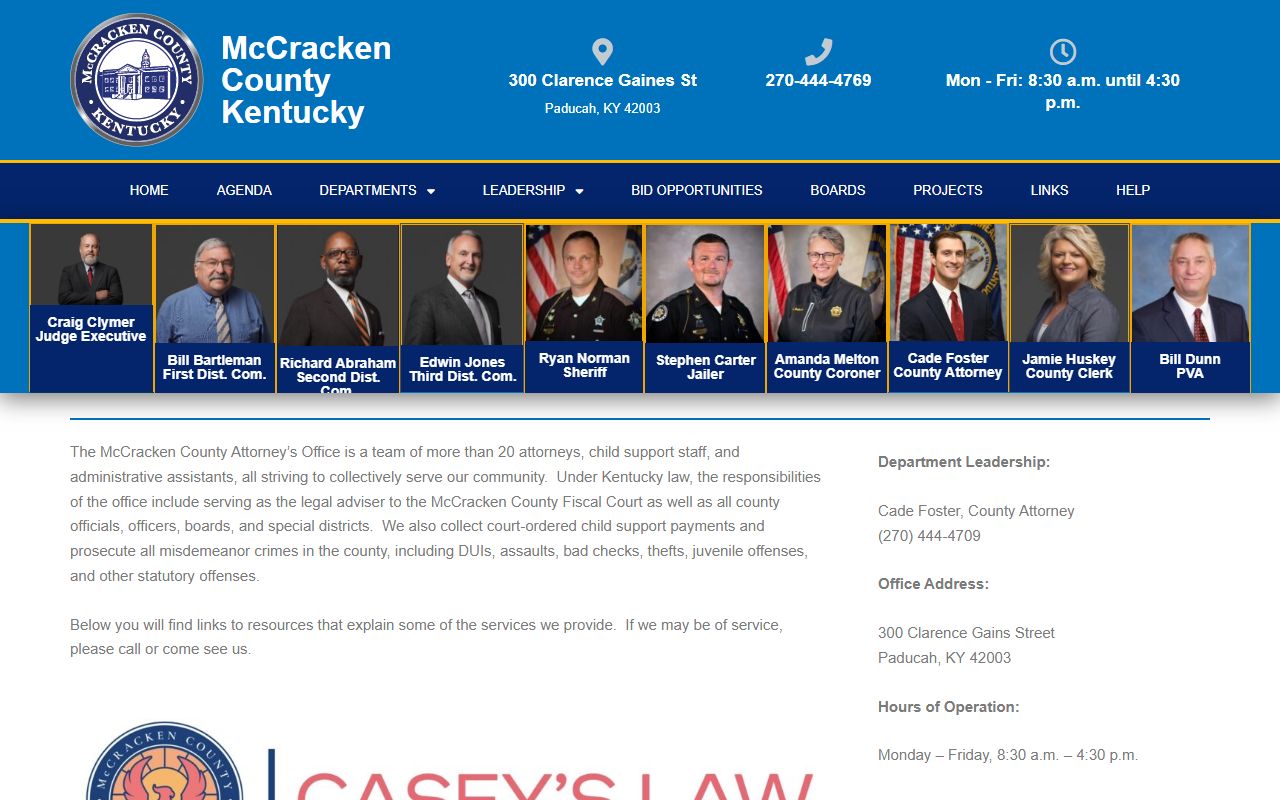
The County Attorney role matters because District Court violations, misdemeanors, and many early criminal proceedings can be tied to that prosecutor's filings before the case reaches a final court record.
McCracken Criminal Record Fields
A criminal court record may show more than a list of charges. It can tie the defendant, court division, prosecution, judge, docket events, documents, bond, financial terms, and final disposition into one case. Online results may be partial, and document images may require account access, clerk review, or in-person copy processing.
| Field | What It Shows |
|---|---|
| Case Number | Kentucky criminal case identifier, usually tied to year, type, and sequence. |
| Defendant | Name of the person charged; other identifiers may be limited or redacted. |
| Court and Judge | District or Circuit Court, local division, and judge when assigned. |
| Charges | Offense description, statute, count, class or degree, and amendments where public. |
| Bond | Bond amount, type, conditions, or no-bond status when shown. |
| Docket Events | Arraignment, preliminary hearing, motions, continuances, plea, trial, sentencing, or appeal. |
| Plea and Disposition | Guilty, not guilty, dismissed, amended, acquitted, convicted, or otherwise disposed. |
| Sentence | Jail, prison, probation, fines, costs, restitution, treatment, or other terms if ordered. |
Charges vs Convictions
A charge is an accusation filed with the court. A conviction is a final finding after a guilty plea, verdict, or qualifying judgment. McCracken County criminal court records can show charges that were later amended, reduced, dropped, dismissed, or resolved without conviction. That is why the disposition line matters as much as the first charge line.
| Point | Charge | Conviction |
|---|---|---|
| Stage | Filed near the start of a case. | Entered after plea, verdict, or judgment. |
| Meaning | An accusation that must still be proved or resolved. | A final criminal outcome on that count. |
| Record risk | Can be misread if disposition is ignored. | Still must be read with sentence and expungement status. |
The Cade Foster County Attorney bio describes the County Attorney's District Court prosecution duties and county legal-counsel role.
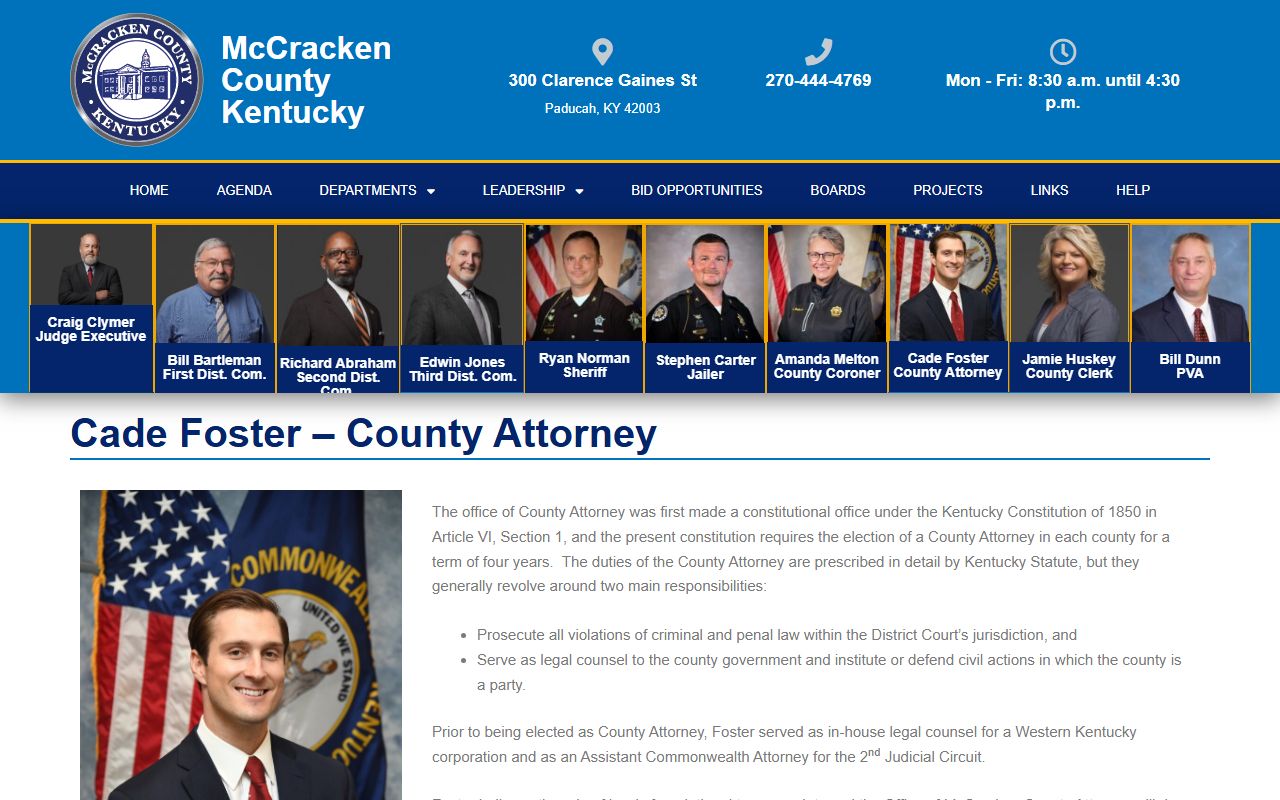
That local prosecution role is one reason misdemeanor and violation records in District Court should be read by charge, plea, disposition, and sentence rather than by arrest alone.
McCracken Criminal Court Levels
Court level changes are common in criminal records. District Court handles misdemeanors, violations, traffic misdemeanors, first appearances, arraignments, bond settings, and felony probable-cause hearings. If probable cause is found and the felony is indicted, the case can move into Circuit Court. Circuit Court then holds the felony arraignment, motion practice, plea or trial, final judgment, sentencing, probation terms, restitution orders, and appeal notices.
This split matters when reading old and new entries together. A person may have a District Court docket entry from the arrest stage and a Circuit Court case number after indictment. The first record may explain bond or probable cause, while the later record carries the felony disposition and sentence. If a search returns only one level, check the other court level or call the Circuit Court Clerk's criminal division before assuming the record is complete.
Traffic misdemeanors and failure-to-appear matters may also sit in District Court even when they have criminal consequences. A bench warrant line, bond change, or payment entry should be checked against the latest docket because the status can change after a new appearance or recall order.
- Arraignment
- The hearing where charges are addressed and plea or bond issues may be set.
- Disposition
- The final outcome of a charge or case, such as conviction, dismissal, acquittal, or other resolution.
- Sentence
- The punishment or court terms ordered after conviction, including jail, prison, probation, fines, costs, or restitution.
Sealed vs Expunged Criminal Records
Sealing and expungement affect public access in different ways. A sealed record is hidden from general public access by law or court order. An expunged record is removed or deleted from official state-performed background checks after the statutory process is complete. In Kentucky, eligibility depends on the charge, conviction level, waiting period, completion of sentence, later offenses, and required filings.
| Point | Sealed | Expunged |
|---|---|---|
| Public visibility | Hidden from ordinary public lookup. | Removed or deleted from official state-performed background checks. |
| How it happens | Court order, statute, or confidentiality rule. | Statutory expungement process filed in the court that handled the case. |
| Kentucky sources | Often tied to juvenile, adoption, mental-health, or sealed-case rules. | KRS 431.073 and KRS 431.079 describe felony expungement and effect. |
The Kentucky Court of Justice expungement process is the official statewide resource for court-file expungement steps.
For McCracken County criminal court records, expungement filings route through the court that handled the case, while any required state background steps follow the KCOJ process.
Public Criminal Court Access
Kentucky open-records law supports access to nonexempt public records. KRS 61.871 favors open examination and strict construction of exemptions. KRS 61.872 addresses public inspection, while KRS 61.878 lists exemptions for privacy, safety, and criminal investigation or litigation records held by county or Commonwealth attorneys. The County Attorney open-records policy cites the criminal investigation and litigation exemption.
Key point: Court case records start with the Circuit Court Clerk; prosecutor work product and investigative files may remain exempt.
Restricted McCracken Criminal Records
Juvenile court records are confidential under KRS 610.340. Sealed cases, expunged cases, protected victim details, minor names, Social Security numbers, financial account numbers, and sensitive addresses may be unavailable or redacted. Law-enforcement attachments and prosecutor criminal litigation records may also be restricted, especially when disclosure would harm an investigation or reveal protected work product.
For defense help, the Kentucky Department of Public Advocacy Paducah Trial Office serves McCracken County and nearby counties. The office lists Holly McNeil as Directing Attorney and represents eligible indigent persons accused of crimes or facing loss of liberty. That office is separate from the clerk and cannot replace an official court-record request.
Certified criminal dispositions should be requested from the Circuit Court Clerk when a court, licensing board, school, employer process, or immigration matter requires official proof. Online summaries are useful for screening, but they are not a substitute for the clerk's certified judgment or disposition. Ask for the exact count and final case number when multiple charges appear.